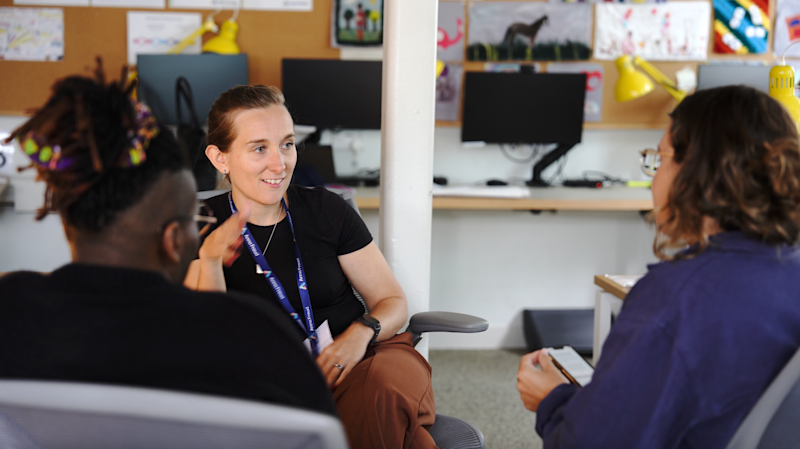
The DPCP course has provided me with a well-rounded education in Psychology, with an outlook that is forward-thinking and requires critical thought [...] it has taught me to value difference and diversity and its impact on one’s experiences.
Developmental Psychology and Clinical Practice, MSc
This two-year, full-time programme combines in-depth study of child development with practical clinical experience in child and adolescent mental health services.

Key information
Course type: MSc
Delivery mode: Campus-based
Study mode: Full-time
Duration: 2 years
Application status: Closed
Start date: September 2026
Location: London (Anna Freud)
Funding available
Programme overview
The Developmental Psychology and Clinical Practice MSc provides a framework for developing an integrated understanding of child development and childhood difficulties, and gives the opportunity to develop practical skills for working with children and families in child mental health services.
The programme draws together theory, research and therapeutic approaches from a range of perspectives including cognitive psychology, CBT, systemic theory, community psychology, psychoanalysis and neuroscience. Alongside working on a research project and learning about child mental health, students develop clinical skills such as how to build therapeutic relationships, carry out assessments, develop formulations and evaluate clinical interventions. These skills are put into practice during a clinical placement.
About this programme
In the first year, based primarily at Anna Freud with some teaching at UCL, you will develop your core knowledge of child development, disorders and research methods, while beginning to gain practical experience of using clinical skills.
In the second year, you will undertake a clinical placement within a child and adolescent mental health setting, supervised by an experienced mental health clinician. Lectures and seminars continue during the second year, whilst you also work on completing your own research project.
Why you should study this programme
Interdisciplinary learning
Develop an integrated understanding of developmental psychopathology from multiple perspectives.

Learn from leading academics and clinicians
Learn from experienced researchers and practitioners, with teaching delivered in partnership with UCL, ranked highest in the UK for Psychology, Psychiatry and Neuroscience.

Clinical placement experience
Gain hands-on experience within a child and adolescent mental health team, with supervision from an experienced clinician.

Practical training in research methods
Build skills to carry out child mental health research, including exploring and evaluating therapeutic interventions.

Entry requirements
Entry typically requires a minimum upper second-class Bachelor’s degree in Psychology from a UK university, or an equivalent overseas qualification.
Relevant experience working with children or adolescents is also required.
The programme is competitive, with approximately 20 places available each year.
Applicants with more relevant experience are likely to have an advantage.
Relevant experience may include:
Professional work with children or young people
Voluntary work with children or young people
Experience in mental health settings
Undergraduate placements involving work with children or young people
Research experience, such as interviewing children or young people
Personal experience, including childminding or volunteering.
Teaching and modules
Child Development, Childhood Difficulties and the Developing Mind
In this family of modules, you will gain an overview of development and psychopathology, as well as a conceptual framework for thinking about the developing mind. Mental health and developmental difficulties which emerge during childhood (e.g. anxiety, neurodiverse conditions such as autism, conduct disorder) are explored from multiple perspectives – psychodynamic, clinical, cognitive behavioural and neurobiological.
Research Skills
Across the two years you will be working on a research portfolio, with opportunities to work within some of Anna Freud’s own research projects, or to work with external partners. All students will be allocated a research supervisor who will guide them and oversee the research project across the two years. During the first year, classes will help you to learn research methods, including practical skills for analysing quantitative and qualitative data. You will also have an opportunity to learn skills for evaluating clinical practice.
Clinical Skills
In the first year you will attend lectures and workshops in which you will develop the skills necessary to engage young people and their families in a clinical setting, through role play, feedback on video performance and specialised teaching. As the year progresses you will begin to integrate understanding from a range of therapeutic modalities to introduce you to ways of undertaking assessments with children and families and to link assessments to case formulation and treatment planning. During the second year you will continue to have lectures, seminars and workshops to support the development of your professional, clinical and reflective skills.
Clinical Placement
During the second year, all students will have the unique opportunity to undertake a placement in a child and adolescent mental health service (CAMHS). Your placement will take place two to three days per week. Clinical placements include a range of CAMHS services, in community-based or specialist settings (e.g. paediatric, school-based, social care, or neurodevelopmental teams). Whilst on placement students will be working as part of a multidisciplinary team and will be supervised by experienced clinicians. You will gain exposure to a range of assessments and interventions with children and families. Placement selection and allocation are arranged by the programme team for all home and overseas students. Students are therefore not required to source their own clinical placements.
Fees and funding
UCL tuition fees are payable per year of study. This is a two-year, full-time programme.
UK students (2026/27): £16,800 (published fees for year one)
International students (2026/27): £39,200 (published fees for year one)
Further information on UCL’s fees (including fee status, fee increases, fee schedules and additional costs) can be found on the UCL prospectus page.
For more information on funding your studies, visit our bursaries and scholarships page.
Apply now
Careers
Graduates from this programme have gone on to work with children and families in various therapeutic settings, or to undertake further doctoral-level clinical training. Some of our graduates may also pursue research careers, including PhD study.
While this MSc does not result in an accredited qualification as a therapist, the core clinical skills and direct supervised experience of working in a CAMHS setting have helped graduates secure posts within the children’s workforce, for example as assistant psychologists, and gain places on doctoral-level professional training courses, including Clinical Psychology and Counselling Psychology.
How to apply
If you are interested in applying for this course, please apply on UCL's website.
This is a popular course, so applications may close early and ahead of the deadline indicated. Early applications are strongly encouraged.
When we assess your application we would like to learn about:
why you want to study Developmental Psychology and Clinical Practice at graduate level at UCL/Anna Freud
what particularly attracts you to this programme
how your academic and professional background meets the demands of this rigorous programme
how this degree fits with your professional development and/or career goals
your experiences of working with children and young people (whether in a professional, voluntary or personal capacity)
your reflections on knowledge and experience gained in this field.
Together with essential academic requirements, the personal statement is your opportunity to illustrate whether your reasons for applying to this programme match what the programme will deliver and to discuss and reflect on your experiences and learning. You may include your personal statement as part of the application form, or attach it as a separate document, not exceeding two pages (single-spaced).
Please note that you may submit applications for a maximum of two graduate courses (or one application for the Law LLM) in any application cycle.
There is an application processing fee for this course of £90 for online applications. Further information can be found on UCL's application fees page.
Apply now-
Programme guide
Download
Take a closer look at the UCL programme, including course content, teaching structure and entry requirements.
Programme FAQs
In collaboration with:

You may also be interested in
-
Early Child Development and Clinical Applications, MSc
This two-year full-time programme combines a multi-perspective theoretical foundation in early child development with a supervised clinical placement, infant observation, and a substanti...

-
Developmental Neuroscience and Psychopathology, MRes
Delivered jointly by two globally renowned universities, this unique two-year full-time MRes offers a multidisciplinary grounding in developmental psychopathology with a strong emphasis ...

-
Bursaries and scholarships
Anna Freud are committed to training a new generation of researchers and practitioners who wish to pursue a career in the field of child mental health.