Connection to prevention: The power of community
At an event attended by our Patron, the Princess of Wales, Nana, Head of Clinical Services at Anna Freud, shared why community is key to improving young people’s wellbeing.
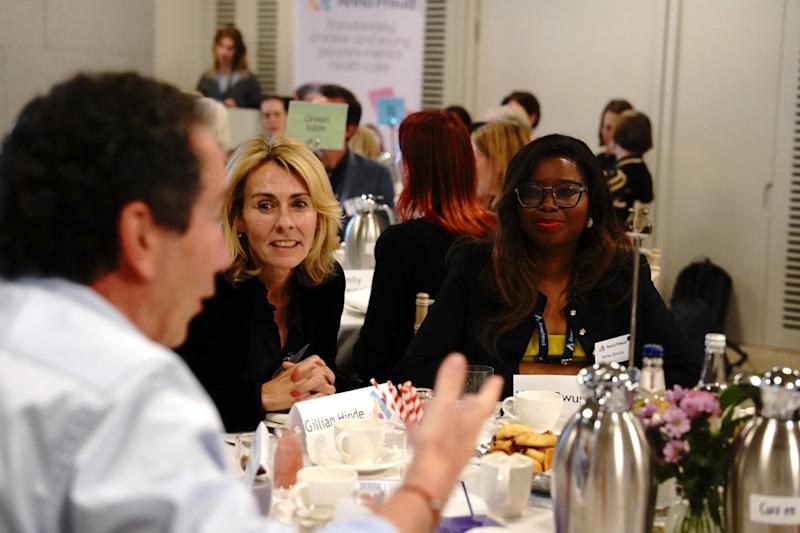
The following is an edited version of a speech Nana gave to guests who attended a special event we held in November, which was attended by our Patron, The Princess of Wales. During the day, we explored the importance of connection for preventing mental health problems. Find out more about The Princess of Wales's visit.
What community means to me
I grew up in West London, just off the A40 where, behind the rows of houses, there were long alleyways. My siblings and I played there with our neighbours’ children, and those alleyways connected all of our homes.
Our local corner shop was run by Mr and Mrs Patel, who knew every single one of us by name and would still let us buy our sweets even if we were a penny or two short. Sometimes, if I went in on my own, Mrs Patel might say, “Your dad didn’t pick up his papers today, take them, and he can sort it out when he comes in next.”
That was my community: safe, familiar, and deeply connected. My family was fortunate, but what made our childhood rich wasn’t what we had; it was the sense of belonging, the trust between neighbours and the everyday relationships that surrounded us.

An age of social ‘thinning’
For many children today, those ordinary moments of recognition, safety, and connection have quietly disappeared. Communities are thinner; familiar faces are fewer. We’ve lost some of those small daily interactions that once held families together.
At Anna Freud, a mental health charity transforming care for children and young people, we know, from the latest evidence and what young people tell us, that trusted relationships in childhood, where children feel seen, valued and loved, form the foundation for lifelong mental health and wellbeing. Relationships are not a luxury; they are the infrastructure of prevention.
A 2024 report on youth-adult relationships from the Search Institute revealed that young people with strong relationships show significantly higher levels of resilience, confidence, and belonging. These relationships don’t appear by chance. They grow in communities, in the places children live and learn, such as parks, classrooms, places of faith, and even corner shops. When those everyday places disappear, the world for a child becomes smaller.
However, between 2010 and 2023, more than 1,200 council run youth centres closed across England and Wales, and local authority spending on youth services has fallen by around 70%. 2025’s Good Childhood Report from The Children’s Society tells us that one in three young people say they do not feel part of their local community.
Our CEO, Professor Eamon McCrory, calls this the ‘social thinning’ of childhood, a loss of the real-world connections that once supported young people. As those spaces retreat, the digital world fills the gap. For some young people, it's the only place they find belonging. You can read more about this in a social thinning think piece Eamon has written in partnership with the Nuffield Foundation published this week.
How Anna Freud is enriching young lives
Anna Freud is uniquely placed to respond to this challenge because we work across every layer of a child’s world, from individual children and their families, to schools, communities and policy makers, using science and lived experience to inform practice.
For example, we are:
Expanding the mental health workforce, training a new generation of researchers and clinicians.
Providing evidence-based therapy for children who have experienced trauma, strengthening the systems and relationships around them.
Delivering mental health support directly in classrooms and online, so help reaches children and young people where they spend most of their time. This includes through our Schools and Colleges Early Support Service.
Developing and leading cutting-edge research – such as the national Growing Up in the 2020s study - helping ensure everything we do is guided by evidence and we understand what works for different groups of young people and in what context.
These are achievements to be proud of. However, if we are to make prevention a reality, we need to go further.
Ensuring no child falls through the gaps
Going forward, here at Anna Freud, we will continue to expand our reach beyond our existing networks, working hand-in-hand with early help services, voluntary organisations, places of faith, and other community spaces where young people already gather and feel at home.
We need to make sure that every child, wherever they live, whatever their background or circumstance, can benefit from the knowledge, skills and relationships that our work helps to create. That includes children growing up in areas of social deprivation, families under economic strain, and those who have historically found it hardest to access help.
Because we know that mental health inequity is not only about individual distress; it is about the uneven distribution of connection, opportunity and safety.
I recently attended the Parliamentary launch of the Black Manifesto, a cross-sector call to improve outcomes for children and families facing inequity. One mother, Debbie, shared her son’s story: a catalogue of missed opportunities, exclusions, and added trauma from the very systems meant to help him. Now in his early twenties, he moves in and out of inpatient care. What has stayed with me is her closing line: “Her son didn’t fall through the cracks; he was pushed through them.”
At Anna Freud, we are finding ways to smooth those cracks in the system, so that no child or family ever falls through them. That means listening to communities as equal partners, building shared language and shared purpose across education, health, voluntary and faith sectors.
If prevention begins anywhere, it begins in our communities, in our relationships, and in those everyday spaces, physical and digital, where every child should feel like they belong.
Support us
Anna Freud has led the way in reimagining mental health care for more than 70 years. Over the festive period, please support us in building a future where every young person receives the right support at the right time.