Grace and Emily take their message on wellbeing to Westminster
Anna Freud Young Champions, Grace and Emily, back the call for a national wellbeing measure in personal letters to the Secretary of State for Education.
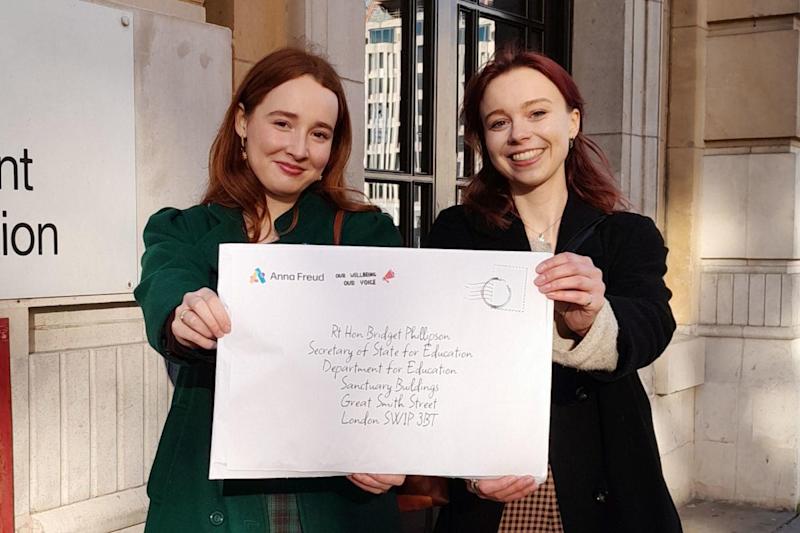
Last week Anna Freud Young Champions, Grace and Emily, took direct action to support the Our Wellbeing Our Voice campaign, backed by Anna Freud. This support saw them hand-deliver personal letters to the Department for Education, addressed to the Secretary of State, Bridget Phillipson MP.
In their letters, Grace and Emily described their mental health journeys in poignant detail, and call on the Government to take urgent action to better understand and address the low wellbeing of children and young people across England.
The Our Wellbeing, Our Voice campaign, is supported by more than 50 organisations. It has one simple call to action: include a national wellbeing measure in the upcoming Children’s Wellbeing and Schools Bill.
Grace and Emily are strong supporters of this vision and understand the positive impact it could have. In this extended blog, they tell us more about their motivations, what they hope to achieve, and how other young people could advocate for change in this way.
Grace, 19, from Dorset, said:
“Hello, I'm Grace and I've been a young champion at Anna Freud for two-and-a-half years.
"I've been involved in advocacy since I was 13 - first running for Youth Parliament and getting involved in my local council and then volunteering with the British Youth Council. I have also given a TEDx talk titled, "Young People Are Our Future", advocating for the better inclusion and representation of young people in the decisions affecting us.
"Fundamentally, participation to me is about meaningful, non-tokenistic engagement of young people within the policies, subjects and motions that will affect our future.
"For me, the Children’s Wellbeing and Schools Bill, at its foundation, aims to improve the futures of young people, hence my excitement to influence it by sharing my voice and my experience of mental health problems, as it passes through parliament.
"Mental health support is a subject very close to my heart, due to my experiences accessing local authority and school services, and I explained all of this in my letter to the Secretary of State.
"Throughout my own mental health recovery, I felt angry and let down by a system that allowed long wait times, ineffective care and barricaded access to support. The Children’s Wellbeing and Schools Bill is a perfect opportunity to reform the system at a policy level. I believe that part of this reform should be through implementing a national wellbeing measurement, that collects quantitative and qualitative data on young people's wellbeing, but also about the most effective strategies to help.
"When I first ran for youth parliament at 13, my hope was that no person would have the same struggle through the mental health support system as me. At 19, with this Bill, we have the chance to make this a reality.
"It is crucial to the success of this Bill that young people are consulted. I have been a name on a three-month waitlist, I have had weeks out of lessons, I have had times where I was told I would not have a future and I have fought to make sure the system changes for six years. I am just one expert by experience, but there are thousands of young people like me who have gone through the system too, they need a chance to have their say too.
"We are at the pinnacle of making young people's mental health a priority in the education system. I recommend that other young people write their own letters, make their own social media posts, or start their own campaigns on what they think should be included in this Bill, before it’s too late.”
Emily, from Wiltshire, said:
“My name is Emily, and I’ve been an Anna Freud Young Champion for two and a half years. When I first joined, I didn’t fully understand how powerful participation could be. Over time, it’s become a way for me to reframe my lived experiences of mental health difficulties into something constructive.
"For me, participation means genuinely listening to young people and recognising that lived experience is expertise. It’s about giving young people the space, respect, and influence to shape decisions that could change lives. Most of all, participation is about visibility: making sure no young person’s voice, needs, or distress goes unnoticed or unheard.
"I wanted to take part in this action because I’m passionate about the vital role schools play in young people’s wellbeing. Schools are often the first place signs of distress appear, and they should be places where problems are recognised. In my own secondary school, mental health simply wasn’t understood. Staff didn’t have the tools or training to recognise what I was going through, and as a result, I fell through the cracks.
"Getting involved in this campaign felt like a chance to push for something that would have made a real difference in my own life. It was an opportunity to use my lived experience to advocate for a system that could help thousands of young people today, especially those who may not have the confidence or platform to speak up themselves.
"One of the key things I wanted to get across in my letter is that behind every statistic is a real young person. Whether or not their difficulties are recognised early can drastically alter the course of their life. I wanted to show both the personal cost of missed intervention and the hope that timely support can offer.
"A national wellbeing data collection system would help us spot early signs of distress, provide timely support, reduce inequality in access to help, and shift our national approach to preventing a crisis.
"It’s important to me that the government hears directly from young people with lived experience. Lived experience shows what data alone can’t - the emotional reality of struggling without support, the moments that adults miss, and the pressures young people carry quietly.
"Young people are the ones most directly affected by policy decisions, and we often see needs, gaps, and opportunities that professionals may overlook. When lived experience informs policy, the result is stronger, fairer, and more realistic. It helps ensure that the systems designed to support young people actually meet their needs.”

About the Our Wellbeing Our Voice campaign
Anna Freud is part of Our Wellbeing, Our Voice through our work on #BeeWell. #BeeWell was co-founded by The University of Manchester, The Gregson Family Foundation and Anna Freud in 2019, and developed in partnership with the Greater Manchester Combined Authority. In 2023 #BeeWell expanded into Hampshire, Isle of Wight, Portsmouth, and Southampton.
The Our Wellbeing Our Voice campaign is run by a coalition of partners including: PBE, The Children’s Society and Fair Education Alliance. The campaign is calling on the government to implement a national wellbeing measurement programme to address the needs of children and young people across England. This is a call we made too in our 2024 manifesto.
Next steps
Thanks to Grace, Emily and all the other young people who have actively shared their experiences and views with the Department for Education on this issue. We will be eagerly waiting to hear the Secretary’s response and will continue calling for a wellbeing measure to be included in the Children’s Wellbeing and Schools Bill.