I think there’s got to be some kind of single point of access. And that’s got to have the holistic overview and the knowledge of all the different sorts of services and interventions that might be needed on that woman’s particular journey.
The INTEGRATE report
The INTEGRATE report outlines a practical approach to integrating psychological support for common mental health difficulties during pregnancy and after birth within universal services.

Background to the report
Around 1 in 4 women and birthing people in the UK experience mental health difficulties during pregnancy or the year after birth. Most face mild to moderate challenges, what we call “common mental health difficulties”, which often fall below the threshold for specialist NHS services. Yet these difficulties can have lasting impacts on parents, babies, and family relationships if left unaddressed.
While specialist services exist for those experiencing moderate to severe mental health challenges, those with common difficulties often encounter fragmented systems and gaps in care. This report calls for urgent action to integrate psychological support within universal services, such as midwifery, health visiting, and general practice so that everyone receives timely, compassionate, and effective care.
About the report
The INTEGRATE project aimed to develop an implementation framework for piloting an integrated mental health workforce in maternity services. This integration would facilitate the delivery of evidence-based interventions for women and birthing people with common perinatal mental health problems in a timely, holistic and family-centred way. The implementation framework was developed by conducting a rapid review of the published literature on “what works” when integrating mental health services in physical health settings.
The literature review was further supported with a series of interviews with stakeholders currently involved in delivering both maternity/child health and low intensity psychological services in the UK - such as national NHS commissioners and service managers, front line practitioners, experts by experience, and third sector leaders. The implementation framework aimed to describe the facilitators, barriers, best practice models, and impact metrics so it can be easily operationalised for testing in a future pilot.
Aims of the report

Evidence base
To scope evidence for integrating low-intensity support.

Barriers and best practice
To identify UK barriers, enablers and best practice.

Implementation framework
To develop a framework to pilot integrated care models.
How was this report developed?
The INTEGRATE project was conducted between October 2024 and March 2025. The project comprised of two stages:
A rapid scoping review of the barriers, facilitators and models of promising practice when integrating psychological support into universal care for birthing parents with common mental health difficulties.
A series of fifteen professional and ten expert-by-experience interviews to understand gaps in the perinatal mental health service delivery landscape, explore new models of integrated care, and scope what it would take to implement such a model within universal services in England.
The report was also shaped by a joint roundtable discussion with local and national leaders.
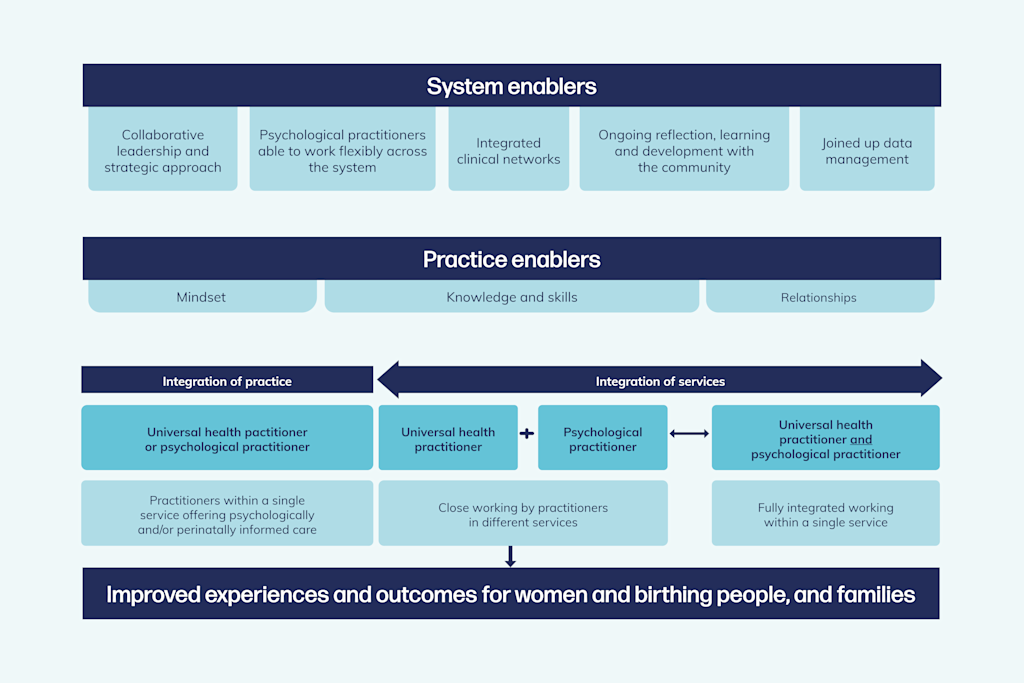
The INTEGRATE model
System enablers support the effective design, commissioning and operation of integrated services, including collaborative leadership, psychological practitioners able to work flexibly across the system, integrated clinical networks, ongoing reflection and learning with the community, and joined-up data use.
Practice enablers help professionals work effectively across different models of integration, including a shared (perinatal) mindset, system knowledge and perinatal practice skills, and collaborative relationships.
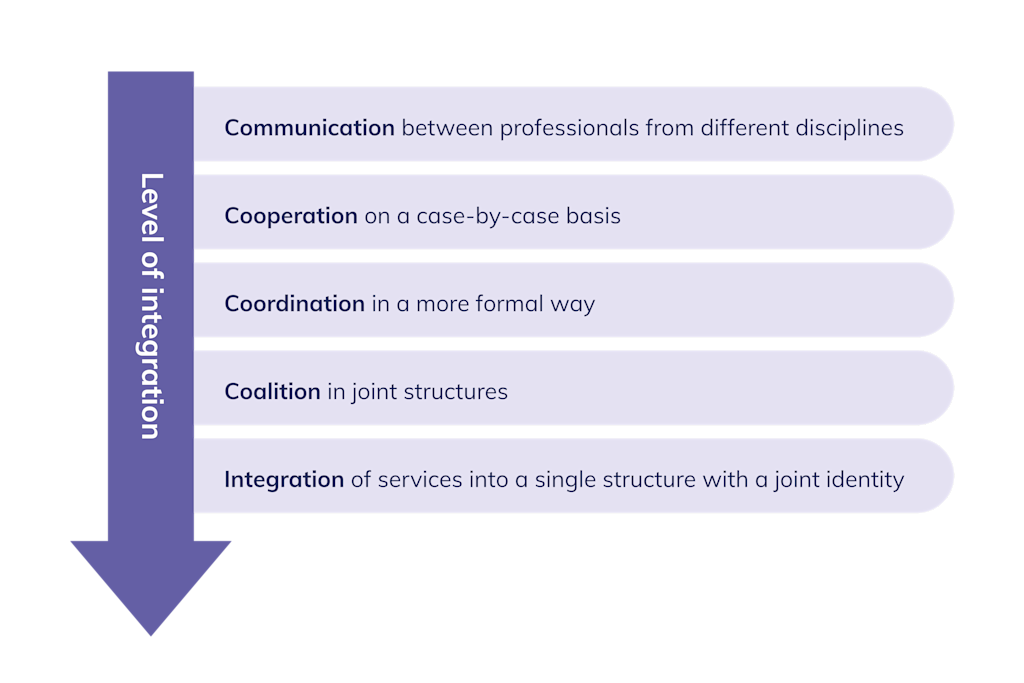
What are the levels of integration of services?
The integration of services involves different services (or different professionals) working closely together.
Joint working between professionals from different services can take many forms, from communication to structural integration, as illustrated in the diagram.
Key insights from the report
The challenge
Specialist perinatal mental health services across the UK provide excellent care for moderate to severe needs, but support for common mental health difficulties remains fragmented. Many women and birthing people experience gaps in care and lack clear pathways of support.
What the evidence shows
Research and expert-by-experience insight highlight an urgent need for better integrated care. The report explores existing models of integration and sets out a gold-standard approach, where a single perinatal mental health service works flexibly across the system to deliver evidence-based care for all levels of need.
What’s needed
Gold-standard integration requires a dedicated workforce. Analysis indicates that around 518 full-time equivalent psychological practitioners are needed, in addition to existing specialist services, to support women and birthing people with mild to moderate difficulties.
Why this matters
The INTEGRATE report provides practical guidance for practitioners, service providers, commissioners and policymakers to help create more responsive and equitable perinatal mental health support.
View the full reportBenefits of integrated services for women and birthing people

Early identification
Improved identification of difficulties

Reduced difficulties
Reductions in mental health difficulties

Improved accessibility
More accessible services and a reduction in stigma associated with mental health services

Timely support
More timely, appropriate care provision
Implementing an integrated offer in your area
The INTEGRATE report provides examples of integrated support and proposes a gold-standard model as inspiration to local systems.
The ‘Good Practice Checklist’ on page 43 of the report can be used to help you review how successful your service or system integrates perinatal mental health support.
Meet the research team

Camilla Rosan
Project Lead
Dr Camilla Rosan is a consultant clinical psychologist and associate professor specialising in perinatal mental health and early child development. She was the Project Lead of the INTEGRATE project. Her research focuses on health inequalities in perinatal mental health and translating evidence into policy and service improvements. She is Chair of the BPS Faculty of Perinatal Psychology and Academic Director of the Doctorate in Clinical Psychology at King’s College London.

Kim Alyousefi-van Dijk
Project Manager
Dr Kim Alyousefi-van Dijk is a Senior Research Fellow at Anna Freud and UCL. Her research focusses on the effects of complex trauma and psychosocial disadvantage on perinatal mental health and the parent-child relationship. She contributed to INTEGRATE as a Project Manager.

Hannah Hopson
Research Assistant
Hannah is an early-career researcher whose work focuses on perinatal mental health, couple relationships, and the effectiveness of interventions. She contributed to the INTEGRATE project as a Research Assistant, where she conducted participant interviews and supported qualitative data analysis.

Lani Richards
Parent Research Assistant
Lani has worked on other perinatal projects as a Patient and Public Involvement and Engagement (PPIE) Lead, and supported the INTEGRATE project by shortlisting and interviewing lived experience participants, as well as contributing to qualitative data analysis.

Dr Alice Haynes
Head of Implementation and Service Evaluation
Dr Alice Haynes is Head of Implementation in the Clinical Division at Anna Freud. She has over 10 years’ experience of working in perinatal and early years research, policy and practice, and holds a PhD in social work and psychology.
For any questions about the report, please contact us.