Advice for parents and carers: talking mental health with children at primary school
A tip sheet for parents and carers sharing advice on talking about mental health with primary school children.
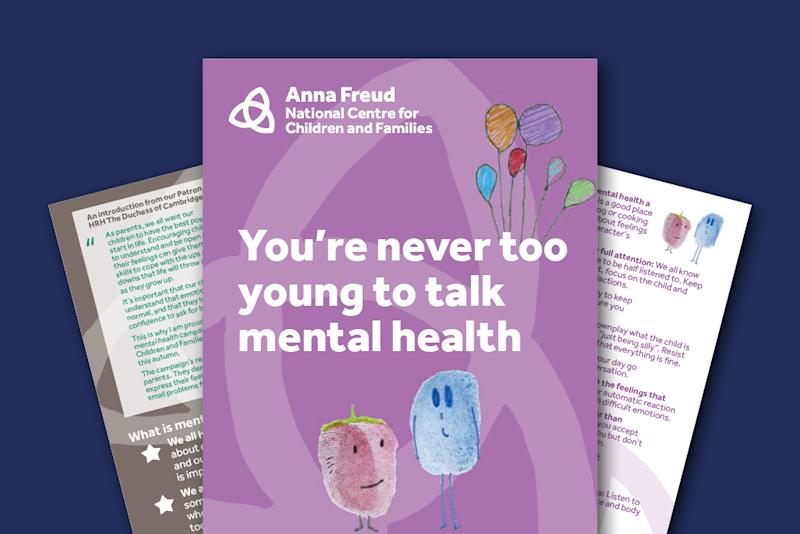
This leaflet which was created alongside the Talking Mental Health Animation & Toolkit features an introduction from our Patron, Her Royal Highness The Princess of Wales who supported the You're never too young to talk mental health campaign stating the campaign's resources "demonstrate how we can help children express their feelings, respond appropriately, and prevent small problems from snowballing into bigger ones."
An introduction from our Patron, HRH The Duchess of Cambridge
As parents, we all want our children to have the best possible start in life. Encouraging children to understand and be open about their feelings can give them the skills to cope with the ups and downs that life will throw at them as they grow up. It’s important that our children understand that emotions are normal, and that they have the confidence to ask for help if they are struggling. This is why I am proud to support the You’re never too young to talk mental health campaign by the Anna Freud National Centre for Children and Families, which is being rolled out across primary schools this autumn. The campaign’s resources are excellent tools to support parents. They demonstrate how we can help children express their feelings, respond appropriately, and prevent small problems from snowballing into bigger ones.
What is mental health?
We all have mental health. Mental health is about our feelings, our thinking, our emotions and our moods. Looking after our mental health is important.
We all have small feelings every day: These sometimes feel strong and overwhelming, whether happy or sad, but they go away before too long.
Sometimes we experience big feelings: These feel strong and overwhelming for a long time. They stop us doing what we want to in our lives.
Tips for talking to children about their feelings
Make conversations about mental health a normal part of life: Anywhere is a good place to talk; in the car, walking the dog or cooking together. Model everyday talk about feelings such as by talking about a TV character’s feelings.
Give your full attention: We all know it’s horrible to be half listened to. Keep eye contact, focus on the child and ignore distractions.
Check your body language: Try to keep it open and relaxed and make sure you come down to the child’s level.
Take it seriously: Don’t downplay what the child is saying or tell them they’re “just being silly”. Resist the urge to reassure them that everything is fine.
Ask open questions: Such as “How did your day go today?” This will help to extend the conversation.
Calmly stay with the feelings that arise: It can be our automatic reaction to steer away from difficult emotions.
Offer empathy rather than solutions: Show that you accept what they are telling you but don’t try to solve the problem.
Remember we are all different: Respect and value the child’s feelings, even though they may be different to yours.
Look for clues about feelings: Listen to the child’s words, tone of voice and body language.
Some ways to start a conversation about feelings might be: “How are you feeling at the moment?” “You don’t seem your usual self. Do you want to talk about it?” “Do you fancy a chat?” “I’m happy to listen if you need a chat."
Sign up to our newsletter
Anna Freud's newsletter provides updates of the latest news, research, events and fundraising activities.